









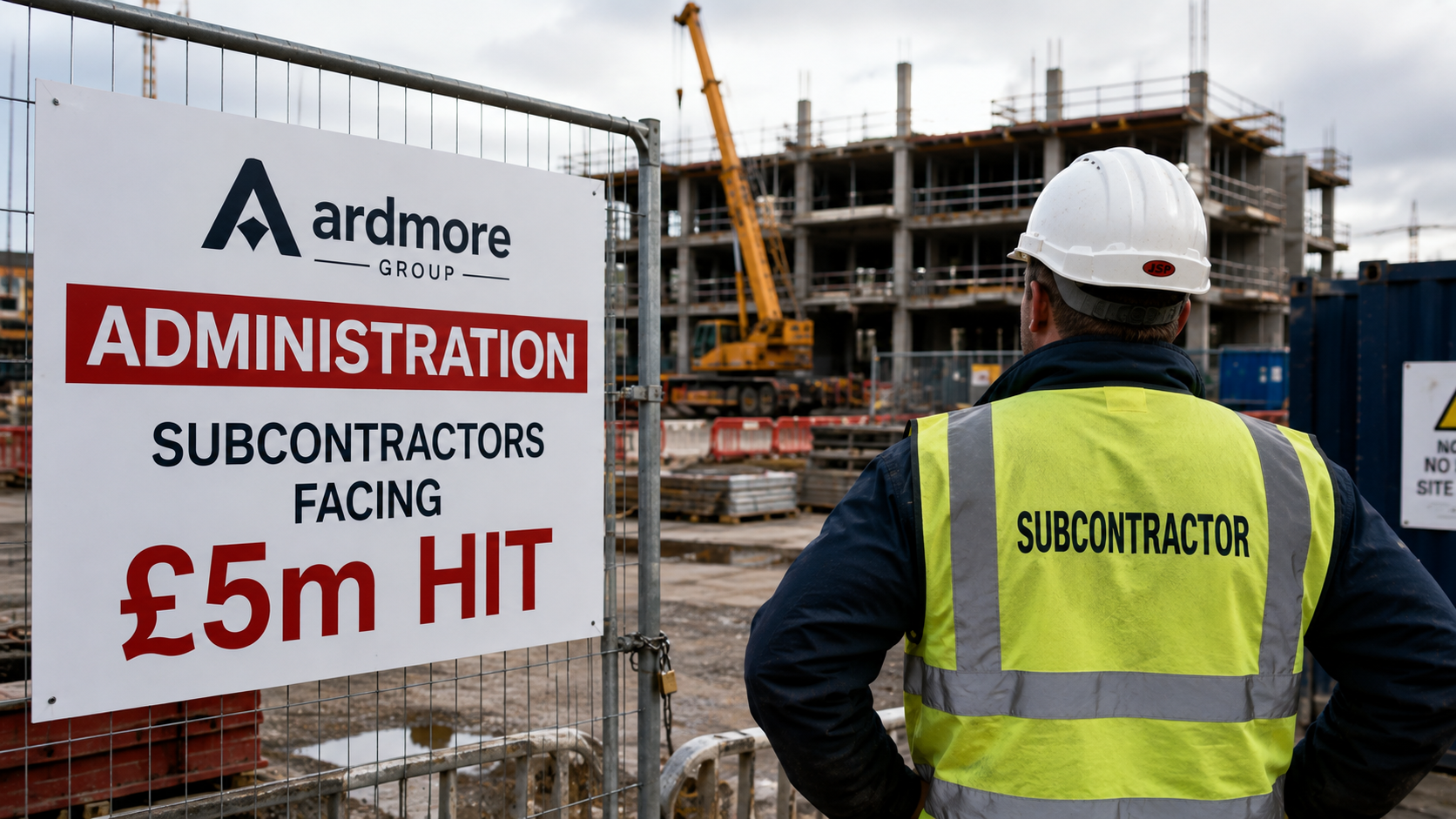
The £344 million-turnover company entered administration in June after losing a judgment requiring it to pay £14.9 million to Crest Nicholson. The payment related to an adjudication against Ardmore Construction Ltd, which itself entered administration in August 2025.
Ardmore Construction Group was one of seven linked companies held liable for the payment under a building liability order (BLO).
A report by administrators BTG, filed at Companies House this week, said Ardmore Construction Group was placed into administration following the judgment to protect the group’s assets.
“The decision was made to place the company into administration prior to Crest obtaining a final charging order in order to safeguard the assets of the company and also as part of a strategy for group companies subject to the same ruling,” it said.
An appeal against the judgment is still being considered, according to the report.
Ardmore’s parent company, Ardmore Group Ltd, continues to trade and is currently protected from creditor action by a moratorium.
BTG said any payment to Crest Nicholson would come from insurance. Any amount not covered by Ardmore’s insurance policy would be treated as an unsecured claim, with little prospect of recovery.
Unsecured creditors are currently estimated to be owed £10.6 million in total. This includes £5.1 million owed to subcontractors and £1.8 million owed to 132 former employees.
The report said no recovery is currently expected for unsecured creditors.
Ardmore could also face a further 23 potential BLO claims linked to work carried out by Ardmore Construction Ltd. The claims could have a combined value of around £300 million.
Ardmore Construction Group Ltd was established in 2019 as a holding and central support company. It later took on some contracts from Ardmore Construction Ltd and secured new tenders.
The May judgment in favour of Crest Nicholson related to cladding defects at 19 residential buildings within the Admiralty Quarter development in Portsmouth.
Mr Justice Constable rejected Ardmore’s argument that insolvency was “almost inevitable” if the adjudication payment was upheld.
His judgment said: “I do not consider that the BLO defendants have demonstrated any inability to pay. For the same reasons, I am unpersuaded that there are any exceptional facts which might render it appropriate to permit the BLO defendants additional time to pay.”
The judge also criticised Ardmore for providing different indications of its cashflow position. He added that even if there was a risk of insolvency, Ardmore chairman Cormac Byrne had a “reported (and not refuted)” personal fortune built through the company and other investments.
This, he said, was “significantly” more than sufficient to allow the group to continue trading despite the obligation on the BLO defendants to pay the judgment sum.








 English